
Tag Archives: EMPATHS
New Online Training Opportunity
 HERITΛGE, a proud member of the EMPATHS consortium, is pleased to announce that registrations are now open for the EMPATHS online training modules on Participatory Heritage Interpretation.
The EMPATHS Training Programme is designed for heritage professionals who want to explore how heritage interpretation can become more participatory, inclusive, and community-centred. Through interactive and practice-based learning, the programme invites participants to rethink the role of heritage professionals as facilitators of dialogue, co-creation, and shared meaning-making.
The programme is being delivered as part of EMPATHS, an Erasmus+ co-funded European project that brings together partners from across Europe to develop new approaches, methods, and tools for participatory heritage interpretation.
The training consists of six live online sessions organised through three regional hubs in Greece, Italy, and Austria-Slovenia. Participants will engage in collaborative learning experiences that include group discussions, breakout activities, reflection exercises, peer exchange, and the practical application of participatory methods.
The programme is open to professionals working at the intersection of heritage and communities, including:
- Museum professionals
- Cultural heritage practitioners
- NGO and civil society actors
- Local authorities
- Tourism professionals
- Educators and facilitators
Participants who successfully complete the online training will become eligible to apply for the next phase of the programme: the Interpretive Community Labs.
These five-day in-person co-creation workshops will offer immersive, real-world learning experiences in collaboration with local communities. During the Labs, participants will apply participatory heritage interpretation methods in practice, co-creating interpretation outcomes while working directly within community contexts.
Each hub will host its own Interpretive Community Lab:
Greece Hub
Participants who complete the online training sessions taking place from 22–29 June 2026 will be eligible to apply for the Interpretive Community Lab hosted at the Ethnological Museum of Thrace between 28 August and 1 September 2026.
The Community Lab in Greece will be realised with the support of the John S. Latsis Public Benefit Foundation, which will fund the participation and training of eight trainees, as well as the Captain Vassilis & Carmen Constantakopoulos Foundation, which will fund the participation and training of three trainees as part of its broader mission to foster cohesive and sustainable development with people at its core.
Italy Hub
Participants completing the online training may apply for the Interpretive Community Lab taking place in September 2026 at the Archaeological Park of Campi Flegrei.
Austria & Slovenia Hub
Participants completing the online training may apply for the Interpretive Community Lab taking place from 7–11 September 2026 at the Karawanken-Karavanke UNESCO Global Geopark.
A limited number of participants will be selected for each Interpretive Community Lab through a second application process.
The EMPATHS programme offers participants the opportunity to develop practical participatory skills, strengthen facilitation competences, gain hands-on co-creation experience, and connect with a growing European network of heritage professionals committed to more inclusive and collaborative heritage practices.
Participants who complete the programme will also receive a certificate of participation.
To learn more and apply, visit:
https://empaths-project.eu/participatory-training-programme/
Challenges to participation in heritage interpretation: Insights from the First EMPATHS Sessions in Greece
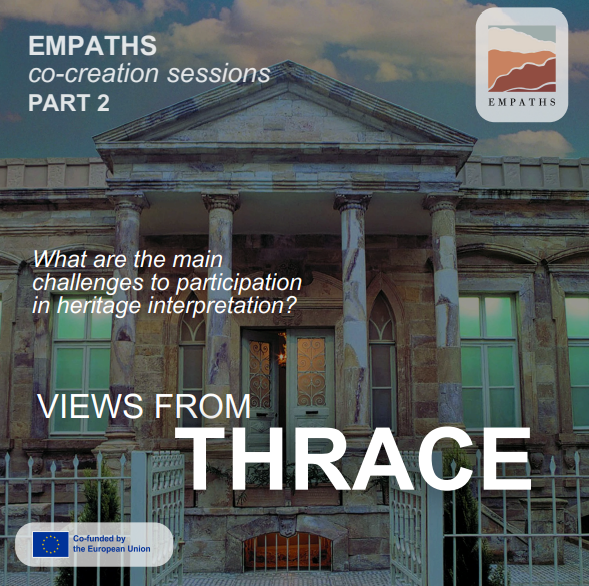
What are the challenges heritage professionals face in developing inclusive and participatory approaches to heritage interpretation? HERITΛGE is a proud partner in EMPATHS, a project co-funded by the European Union to enhance community participation in heritage interpretation and empower heritage professionals.
In the framework of the project, HERITΛGE and the Ethnological Museum of Thrace facilitated two recent co-design sessions held in Alexandroupoli and Rizía, Greece, that explored the realities faced by heritage professionals and cultural organisations in developing inclusive, community-based approaches to heritage interpretation.
In Alexandroupoli, the team worked with Dromeas Thrace, a local group that emphasised the potential of experiential walks that combine local storytelling, well-being, and cultural identity. However, they also highlighted the need for clearer participatory methods, improved internal coordination, and better tools for managing community input.
In Rizía, the local Educational and Cultural Association raised concerns about sustaining volunteer-led initiatives and involving younger generations. Key challenges included a lack of collaboration among local groups, limited access to digital tools, and insufficient training in project design, memory work, and heritage interpretation.
The sessions confirmed the importance of working with existing community strengths while introducing practical tools to ensure sustainable participation. These insights will directly shape the EMPATHS training model, helping to support more inclusive, locally grounded approaches to heritage interpretation across Europe.
The findings of these sessions, as well as a series of others being run by our partners around Europe, are directly informing the EMPATHS training programme scheduled for release in 2026. Find our more on the EMPATHS website.