
Preserving Europe’s Musical Heritage Through Technology: the First MusicSphere Use Case Meeting
 HERITΛGE is proud to be a partner in MusicSphere, a Horizon Europe-funded project and part of the wider European Cultural Heritage Cloud ecosystem being developed through the ECHOES initiative. Bringing together experts in cultural heritage, musicology, conservation, artificial intelligence, digital technologies, and immersive experiences, MusicSphere seeks to transform the way traditional musical instruments are documented, studied, preserved, and experienced.
The project focuses particularly on traditional musical organs and other historically significant instruments, combining advanced 3D technologies, acoustic analysis, artificial intelligence, digital twins, and immersive virtual and augmented reality experiences. By capturing not only the physical form of these instruments, but also their internal structure, mechanical behaviour, sound production, craftsmanship, and interaction with their architectural environment, MusicSphere aims to preserve both the tangible and intangible dimensions of Europe’s rich musical heritage.
On 2–3 June 2026, representatives of the MusicSphere consortium gathered in Thessaloniki, Greece, for the project’s first Use Case Meeting. Hosted by the International Hellenic University (IHU) and LUTHIEROS, the event brought together project partners to review progress, strengthen collaboration, and explore the cultural heritage that lies at the heart of MusicSphere’s research and innovation activities.
HERITΛGE was represented by Dr Aris Anagnostopoulos, who joined fellow consortium members for two days of discussions, cultural visits, and technical exchanges.
Exploring Organ Heritage: From Ancient Innovation to Living Traditions
The first day focused on cultural visits connected to MusicSphere’s first use case, which examines the Hydraulis of Dion within the broader context of Europe’s organ heritage.
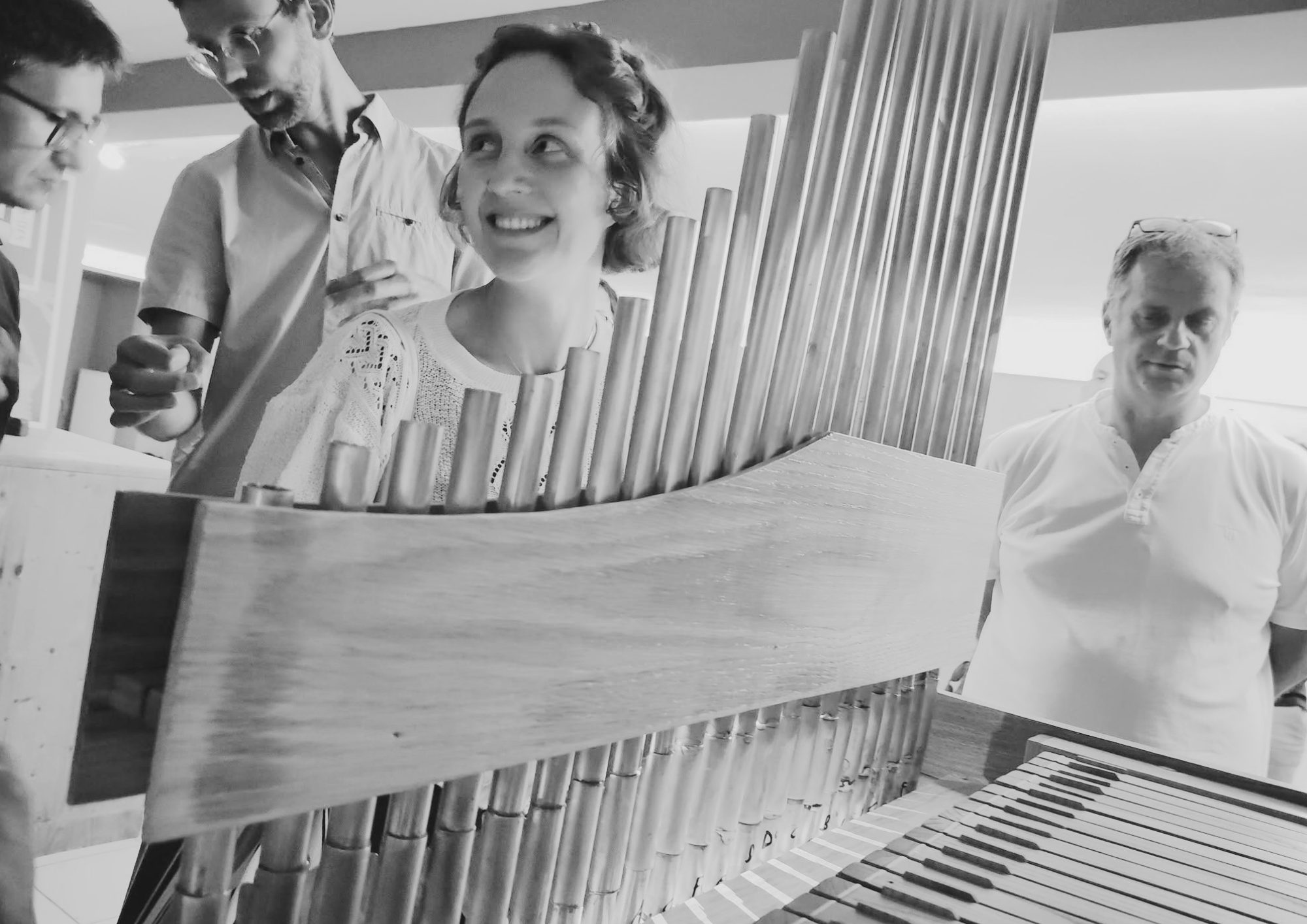
Partners travelled to Katerini to visit the Greek Evangelical Church, home to the largest pipe organ installed in a church in Greece. Built by Weigle and installed in 1980, the instrument features 22 registers and a fully mechanical action system. The visit offered valuable insights into the preservation, operation, and cultural significance of pipe organs, which represent one of the project’s primary areas of focus.
The consortium then visited the Archaeological Museum of Dion, where participants explored the remains of the Hydraulis of Dion, the oldest surviving pipe organ ever discovered and the earliest known keyboard instrument in history. Invented in Alexandria during the 3rd century BCE, the Hydraulis is widely regarded as the technological ancestor of the modern pipe organ and an important milestone in the development of musical instruments.
Although only fragments of the original instrument survive, the Hydraulis provides a fascinating opportunity to investigate the origins of organ technology. As part of MusicSphere’s first use case, partners are exploring how advanced digital technologies can help reconstruct and better understand this remarkable instrument.
The day concluded with a visit to the SEIKILO Museum of Ancient Music in Thessaloniki, including a guided tour and live concert. Managed by MusicSphere partner LUTHIEROS, SEIKILO is the world’s first interactive museum dedicated to ancient music. Visitors can hear, touch, and play reconstructed ancient Greek instruments while exploring the sounds and musical traditions of the ancient world.
Developing Digital Twins for Musical Heritage
A central objective of MusicSphere is the creation of advanced digital representations of traditional musical instruments that capture far more than their physical appearance.
Through the integration of 3D scanning, digital reconstruction, acoustic modelling, artificial intelligence, and immersive technologies, the project seeks to recreate not only the instruments themselves but also their soundscapes, performance characteristics, and cultural contexts. These digital twins will help researchers, conservators, musicians, and the wider public explore and experience instruments that may be fragile, inaccessible, or partially lost.
For the Hydraulis of Dion, this approach offers a way to reconstruct missing components and explore how the instrument may originally have functioned and sounded, despite the fragmented nature of the surviving remains.
Reviewing Progress Across the Project
The second day was dedicated to consortium meetings hosted by the International Hellenic University.
Partners reviewed progress across multiple work packages and discussed upcoming milestones, deliverables, and technical developments. Discussions focused on artificial intelligence algorithms, toolkit architecture, digitisation activities, dataset preparation, acoustic analysis methodologies, and the development of the project’s advanced technological infrastructure.
The International Hellenic University also presented the latest 3D reconstruction of the Hydraulis of Dion, demonstrating ongoing work towards its digital restoration and integration into the project’s Digital Twin framework.
Dedicated technical sessions allowed partners to align requirements, exchange expertise, and coordinate future implementation activities.