
Tag Archives: community engagement
From Memory to Momentum: AHEAD Study Visit in Crete
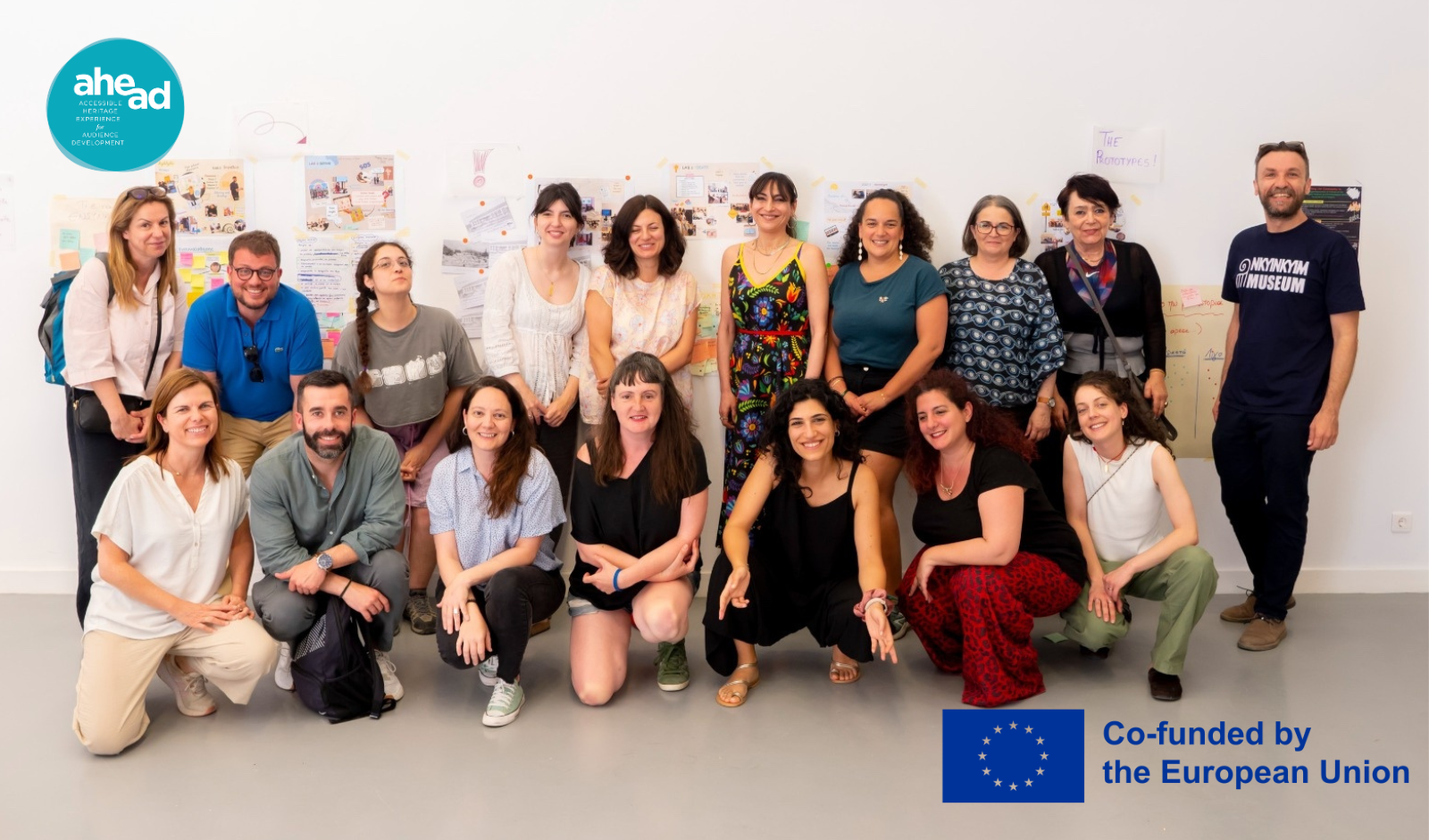
From May 21st to 23rd, 2025, HERITΛGE and the Archaeological Museum of Mesara welcomed partners from across Europe for the second international AHEAD project Study Visit, a key milestone in the project’s mission to foster innovative, audience-centred cultural experiences. The three-day gathering hosted by the Museum (the project’s Greek Hub), proved a dynamic space for reflection, testing, and exchange of ideas across borders and communities.
The AHEAD team along with local heritage professionals and Elektra Angelopoulou – the artist selected to co-create work for the Greek hub- worked to validate and give feedback on the prototypes developed through the AHEAD methodology — a process designed to help cultural institutions understand their audiences, co-create with them, and embed those practices into their operations.
Two Prototypes, Two Publics
The Greek Hub focused on two distinct but equally vital local audiences: children and adults, engaging each group in a meaningful journey through AHEAD’s empathise–define–ideate–prototype–test framework.
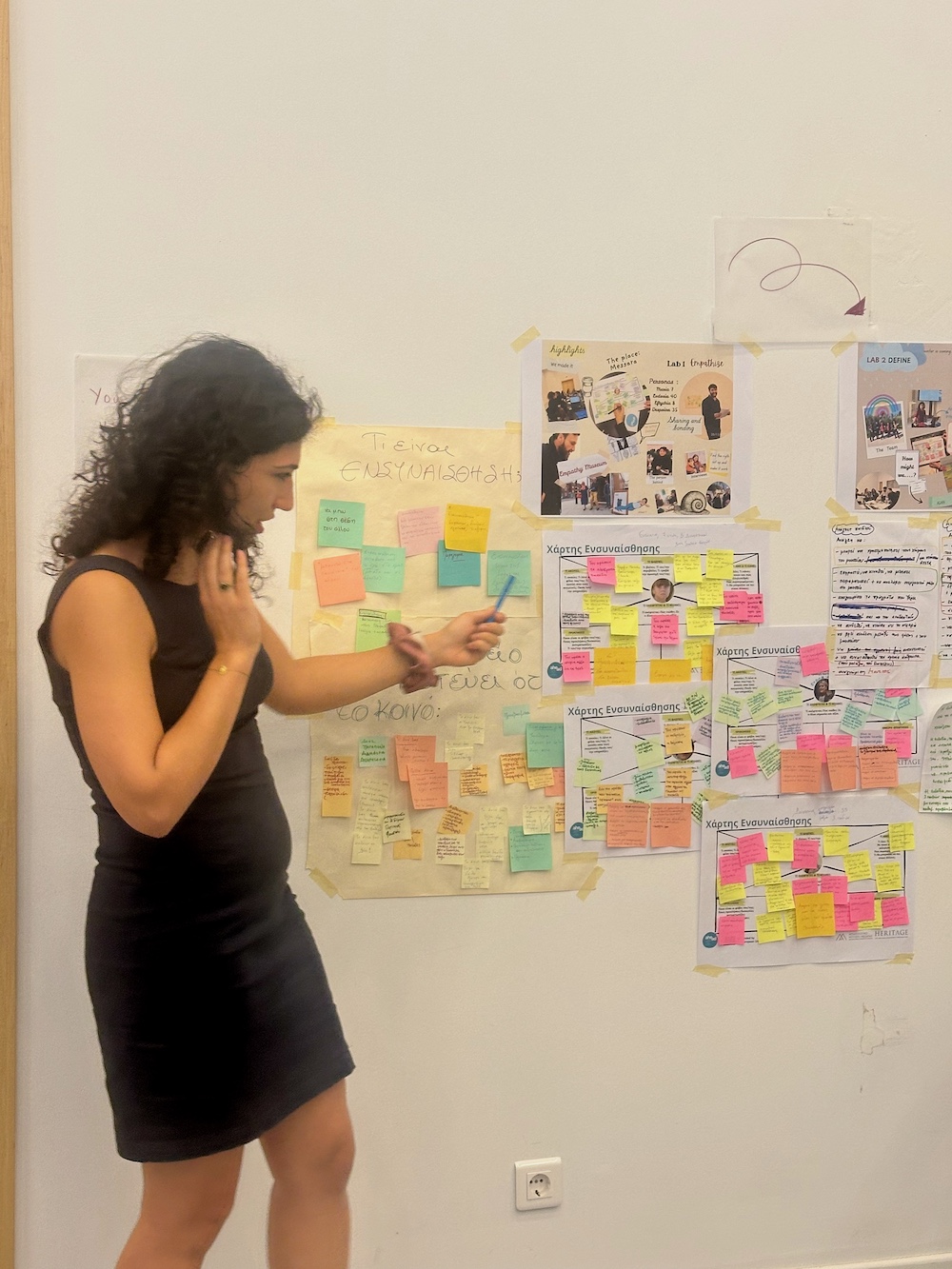
HERITΛGE’s Xanthippi Kontogianni
Prototype I: Children’s Voices in the Museum
HERITΛGE and the Museum partnered with two local primary schools to involve young learners in the creative process. With the participation of artist/performer Elektra Angelopoulou, and through structured activities aligned with the AHEAD methodology, the children explored the museum’s collection and selected their favourite objects.From these choices, the children developed their own narratives — imaginative stories, reflections, and personal interpretations inspired by the artefacts.
In centering children’s voices, the museum embraces storytelling not just as education, but as connection — bridging past and present through creativity, wonder, and the eyes of a new generation.
Prototype II: Community, Connection, and Co-governance
In parallel, HERITΛGE invited local adults to participate in a series of reflective workshops, beginning with the sharing of memories, lived experiences, and deep-rooted connections to the Messara landscape — a place where archaeology, history, and daily life are inextricably linked.
These sessions revealed a strong sense of local pride, but also a disconnect: many felt the museum, though geographically close, was distant in spirit — shaped by state institutions without enough input from those who live nearby. In response, the prototype developed with this audience is the creation of a “Friends of the Museum of Mesara” Association.
This initiative aims to:
– Strengthen community engagement with the museum
– Amplify local voices in decision-making processes
– Support the museum’s role in driving tourism and sustainable local growth
– Provide a formal channel for co-creating future experiences and exhibitions
From Testing to Transformation
Both prototypes were presented to AHEAD consortium members during the Study Visit. Feedback sessions, held at the Archaeological Museum and visits to the area and its archaeological sites Gortyna and Phaistos, allowed partners to gain and exchange insights, and consider how these approaches might be adapted across other contexts.
The feedback underscored the importance of:
- Deep listening and long-term community involvement
- Rethinking traditional exchanges between museums and local communities
- Fostering sustainable links between heritage, education, and local development
- Working with the AHEAD methodology and returning to it as often as necessary throughout the lifetime of a project.
The prototypes — still in development — will be officially launched in September 2025, during a dedicated event that will also feature a site-specific performance by Elektra Angelopoulou, created in collaboration with the Mesara community.
Looking Ahead
This second Study Visit demonstrated the power of co-creation, memory, and local agency in shaping meaningful cultural heritage experiences. By validating the Greek Hub’s work and drawing lessons from the field, partners left Messara not only inspired, but equipped with ideas they could bring back to their own communities.
Next up for AHEAD: Study Visit 3 in Altamira, Spain — where a new chapter of audience-centred innovation is already unfolding.
AHEAD is co-funded by the European Union. To learn more about the AHEAD methodology or how to join the AHEAD network visit the project website and explore the learning resources, manifesto, and upcoming events.
Ενεργοποίηση Κοινοτήτων: Υποτροφίες για το Θερινό Σχολείο στην Πάρο

Ανακοίνωση Υποτροφιών για το Θερινό Σχολείο «Ενεργοποίηση Κοινοτήτων στην Πολιτιστική Κληρονομιά» στην Πάρο
Ο οργανισμός HERITΛGE (Πρωτοβουλία για την Ανάδειξη της Πολιτιστικής Κληρονομιάς), στα πλαίσια της συμμετοχής του στο Δίκτυο Ζώσας Πολιτιστικής Κληρονομιάς, ανακοινώνει την προκήρυξη δυο υποτροφίων για τη συμμετοχή στο Θερινό Σχολείο “Ενεργοποίηση Κοινοτήτων για την Πολιτιστική Κληρονομιά”.
Οι υποτροφίες απευθύνονται σε επαγγελματίες ή ενεργούς πολίτες που δραστηριοποιούνται στη διαχείριση και ανάδειξη της πολιτιστικής και καλύπτουν τα δίδακτρα του θερινού σχολείου. Η διαμονή και η σίτιση των συμμετεχόντων δεν καλύπτεται. Οι εκπαιδευτικές δραστηριότητες του θερινού σχολείου πραγματοποιούνται στα Αγγλικά.
Η μία εκ των υποτροφιών, η οποία προκηρύσσεται σε συνεργασία με τον Δήμο Πάρου, απευθύνεται σε επαγγελματίες ή ενεργούς πολίτες που δραστηριοποιούνται στη διαχείριση και ανάδειξη της πολιτιστικής κληρονομιάς και κατοικούν ή έχουν ισχυρούς δεσμούς με το νησί της Πάρου.
Ημερομηνίες Σχολείου:
• 15–22 Ιουνίου: Διαδικτυακή εκπαίδευση
• 23 Ιουνίου – 6 Ιουλίου: Διά ζώσης εκπαίδευση στην Πάρο
Το πρόγραμμα πραγματοποιείται με την υποστήριξη του Δήμου Πάρου, ο οποίος προσφέρει τη χρήση της αίθουσας Δημητρακόπουλου στην Παροικιά και της Δημοτικής Βιβλιοθήκης.
Κατά τη διάρκεια του θερινού σχολείου, οι συμμετέχοντες θα εκπαιδευτούν σε θεωρητικό και πρακτικό επίπεδο μέσα από διαδικτυακά σεμινάρια και επιτόπια συμμετοχική έρευνα στο πεδίο. Θα εξετάσουν καλές πρακτικές στην ανάδειξη της πολιτιστικής κληρονομιάς και θα ανταλλάξουν εμπειρίες με ειδικούς από όλο τον κόσμο.
Καταληκτική ημερομηνία υποβολής αιτήσεων:
Κυριακή 15 Ιουνίου 2025, ώρα 12:00 μ.μ.
Για να υποβάλετε αίτηση ή να ενημερωθείτε, επισκεφθείτε το https://heritagemanagement.org/training/summer-schools/engagingcommunities/
AHEAD in Crete: Community Stories, Creative Sparks, and New Visions for Heritage Engagement
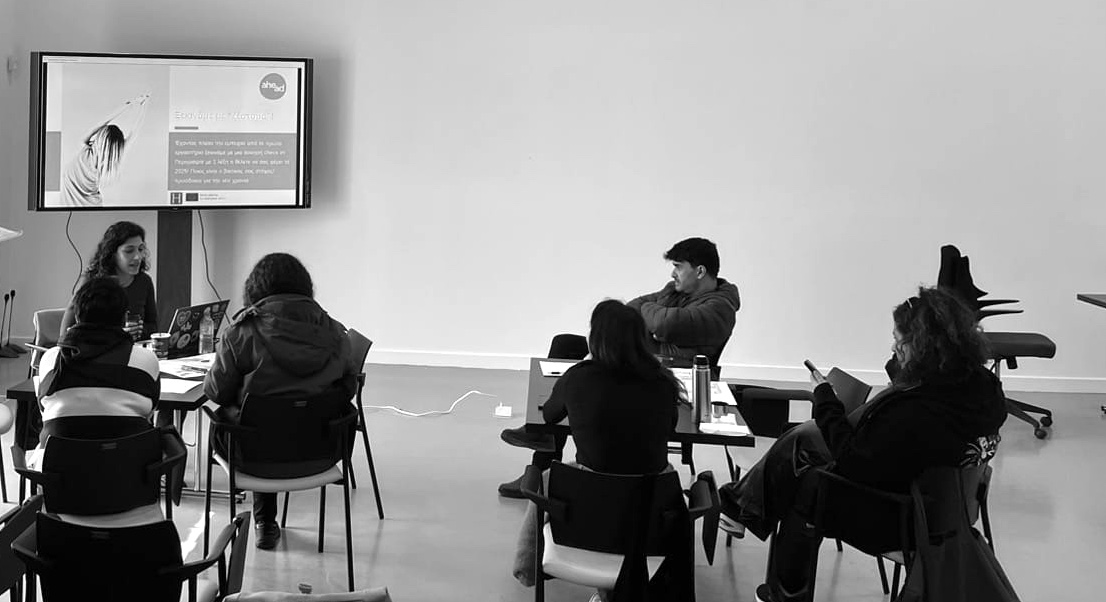
In February 2025, Crete became a vibrant hub for cultural dialogue and creative collaboration through two dynamic AHEAD project activities: the AHEAD Talk at the Archaeological Museum of Mesara and the third AHEAD Lab, held as part of our ongoing mission to foster accessible and participatory heritage experiences.
HERITΛGE is proud to be an active member of AHEAD (Accessible Heritage Experience for Audience Development), a project funded by the European Union’s Creative Europe initiative to give heritage managers the skills and knowledge to held their institutions generate economic sustainability and local growth while widening access and participation to new audiences and local communities.
AHEAD Talk: Memory, Meaning, and Messara’s Cultural Wealth
On February 14th, the Archaeological Museum of Mesara that serves as the project’s Greek Hub opened its doors to a diverse group of heritage professionals, educators, community members, and local stakeholders for the AHEAD Talk. Hosted by HERITΛGE and supported by the AHEAD consortium, the event focused on cultural heritage engagement and audience development, with a spotlight on the unique cultural landscape of Mesara.
Speakers included Aris Anagnostopoulos and Roula Gkika from HERITΛGE, artist Elektra Angelopoulou (who has been selected to co-create a piece of work for the Greek hub in collaboration with local communities, Antonis Papadakis from the Archaeological Museum of Mesara, and local educator Nikos Andreadakis. Speakershared inspiring insights on:
-
The aims and impact of the AHEAD initiative
-
Strategies for community-driven heritage projects
-
Art as a connector between archaeological sites and the public
-
Public archaeology and the use of comics for storytelling
-
Transforming museums into interactive, child-friendly spaces
Beyond the formal presentations, the event came alive through the audience’s contributions—personal stories and heartfelt memories of Mesara’s rich heritage that resonated deeply with all present. The talk fostered meaningful exchange, laying the groundwork for future collaboration between institutions and communities across Crete.
AHEAD Lab 3: Ideate! A Creative Leap in Audience Engagement
In parallel, Mesara also hosted the third AHEAD Lab, titled Ideate! that focused on reimagining how audiences interact with cultural heritage. Building on the themes raised during the Talk, the Lab brought together artists, archaeologists, educators, and local residents for a series of hands-on workshops and co-creation sessions.
Participants explored new methods of engaging audiences—especially young people—through artistic interpretation, participatory storytelling, and site-specific installations. The lab not only generated creative outputs but also deepened local involvement, highlighting the power of collaborative design in shaping inclusive cultural experiences.
Together, the AHEAD Talk and Lab in Crete demonstrated the transformative potential of dialogue, memory, and creativity in heritage work. By listening to communities and co-creating new forms of engagement, AHEAD continues to push the boundaries of how we connect with the past—and with each other.
Find out more about AHEAD on the project’s website.
Engaging Communities in Cultural Heritage Workshop
Over three days in October, fifteen heritage professionals joined our online workshop to learn more about engaging communities in heritage. Community engagement is one of the key strategies in heritage management and allows
HERITΛGE’s Aris Anagnostopoulos and Eleni Stefanou along with the Organization’s Director, Evangelos Kyriakidis, led the workshop, each working with participants on a different section and drawing on case studies from participants’ own work.
After an introduction into how local perspectives are essential in heritage conservation, participants explored the idea of values and examined how the values tied to heritage by the local community make these communities essential stakeholders in safeguarding the knowledge and importance of heritage sites. Over the course of the workshop, participants also learned techniques for engagement through ethnographic research, values identification, collaborative design and representation of the whole community, looking at case studies from around the world and in different types of sites.
“What I liked most about this course was how it showed the importance of involving communities in preserving heritage,” said eter Adewale Jegede, Curator at Nigeria-based On Your Mark. “I now have a better understanding of how to build trust, encourage collaboration, and ensure that heritage initiatives are inclusive and sustainable. This knowledge will help me design projects that respect community perspectives and create stronger connections between people and their cultural heritage.”
Ibrahim Hassan Gafar Ali Fadolr, Director at University of Nyala Centre for Darfur Heritage said that “Major benefits of this training course shall be used in better planning, implementation and review of performance in dealing with communities with different backgrounds, cultures and linguistic variances. ”
“We were lacking skills of how to bring communities at odd to work jointly together to achieve success on behalf of everyone,” he added.
HERITΛGE offers regular 3-day workshops on Community Engagement in Cultural Heritage, as well as an annual Summer Field School, held in Greece and online.
New dates for HERITΛGE summer field schools 2025
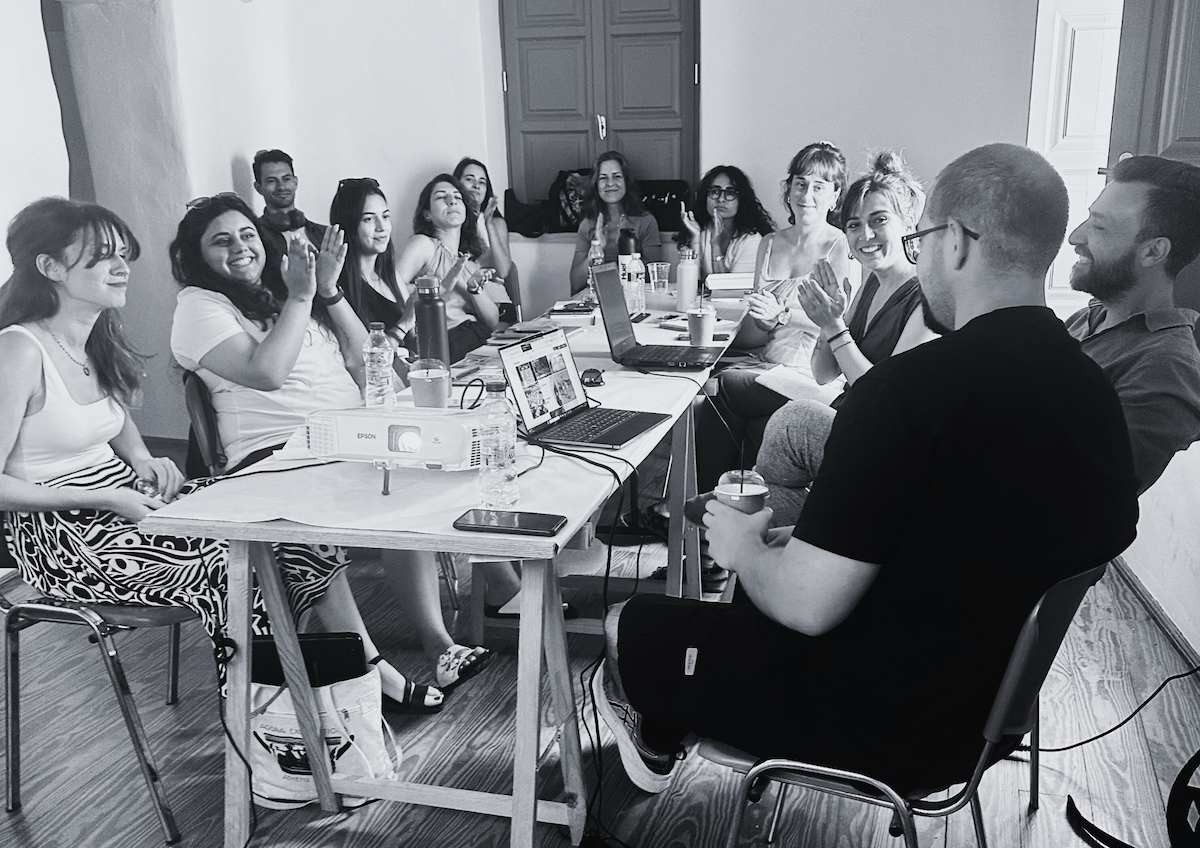
HERITΛGE is pleased to announce new dates for our 2025 summer schools. The HERITΛGE summer schools are excellent opportunities for heritage professionals and students to develop existing knowledge and learn new skills for managing heritage. Applicants do not have to have previous experience in the particular field of study and we welcome students eager to improve their understanding in new areas of heritage. Places are limited so we recommend applying soon!
HERITΛGE is offering two programmes for 2025:
Engaging Communities in Cultural Heritage
Date: 16 June – 6 July 2025
Location: Paros, Greece (in person and online)
Language: English
Lecturers: Dr Aris Anagnostopoulos and Dr Lena Stefanou alongside guest lecturers, Dr
Evangelos Kyriakidis and Vicky Papadimitriou
This hybrid programme aims to develop a different approach to community engagement that is based on social and artistic research with community-led initiatives. Through meetings, assignments and fieldwork, students will be introduced to the principles of community engagement and learn how these can be applied in different circumstances, appropriately addressing cultural differences within the field. The duration of the course is two weeks, with five three-hour meetings. Fieldwork will take place on the island of Paros, in Greece.
I applied to this workshop to improve my fieldwork methodology, and I found it greatly helped
me develop because I was able to learn about those details that we cannot learn without
going into the field and starting to work. It has really helpful for me on how to conduct my
research questions and how to engage with the people I am interviewing. (Elif Aydin, a PhD
Candidate at Istanbul Technical University. Engaging Communities in Cultural Heritage,
2024)
Click here for more information and how to apply.
Digital Tools for Cultural Heritage Management
Date: 13 May-17 June 2024 (applications now open)
Location: Nafplio, Greece (in person and online)
Language: English
Lecturer: Dr Cornelis Stal
HERITΛGE have collaborated with HOGENT University (Belgium) to deliver three integrated and consecutive specialist courses in geomatic topic. These courses will cover GIS, Photogrammetry and image-based 3D modelling, and Terrestrial laser scanning*. Students will be provided with hands-on instruction, hands-on demos and exercises in each. Skills taught will help heritage professionals in restoration, documentation, or visualization projects specifically but can be applied to a range of other fields.
*Please note that these specialist courses can be booked individually. For those intending to just do sections of the field summer school, please contact at the email [email protected] for further information and arrangements.
I decided to take the course because I think it could be very useful in my work both for documenting for the future, using it for planning in daily work with managing heritage buildings. Also to make available on the internet for people who are not able to visit in person.(Helen Myhr Radell, Project Leader, Stiftelsen Skansen. Digital Tools for Cultural Heritage Management, 2024)
It was amazing, moving from place to place from old archaeological sites to old church photogrammetry and dealing with all this senior equipment like drones, laser scanning. Processing all this data gives you fuller information and the full picture about the process so you will then be able to it by yourself! (Khaled Hiatlih, Co-founder Heritage Roots. Digital Tools for Cultural Heritage Management, 2024)
Click here for more information and how to apply:
This course is supported by Metashape.
Introducing the First AHEAD Training Seminar Video
HERITΛGE is excited to announce the release of the inaugural AHEAD training seminar video, Introduction to Audience Development. AHEAD (Accessible Heritage Experience for Audience Development) is a project co-funded by the EU’s Creative Europe program that aims to encourage the cultural heritage sector to adopt human-centered approaches, learning by doing, impact and data-driven methodologies to innovate working practices, become more relevant for our communities, financially sustainable and create opportunities for social, cultural and economic growth.
This first video is hosted by University of Deusto’s Macarena Cuenca and Jaime Cuenca and is part of AHEAD’s comprehensive capacity building program, which aims to equip heritage professionals with the essential tools and knowledge to foster audience development, entrepreneurship, and effective marketing strategies.
Fostering active audience engagement and access to culture is a major challenge for the cultural sector, and one which entails reinterpreting the relationship between cultural organizations and the public. In this context, audience development is becoming a key component of cultural sector strategy, as evidenced by the support for it from the European Commission.
AHEAD’s first seminar is aimed at practitioners working in the cultural heritage sector who are interested in putting audiences at the center of their work and implementing an audience development approach in their organizations. It is made up of two presentations. The first starts with a reflection on the democratization of culture and cultural democracy and related considerations of ethics. It then introduces the concept of audience development. The second presentation is focused on the eight main strategic areas of intervention in Audience Development that were identified in a European-level relevant study on Audience Development (Bollo et al., 2017): Programming, Audience participation and co-creation, Digital, Use of Data, Place, Alliances and Collaboration, Organizational change management, and Capacity building.
Watch the seminar video now to gain valuable insights into the AHEAD program and the importance of audience development in the cultural heritage sector at your convenience. Become a member of the AHEAD network for more news, videos, training opportunities and upcoming events.